
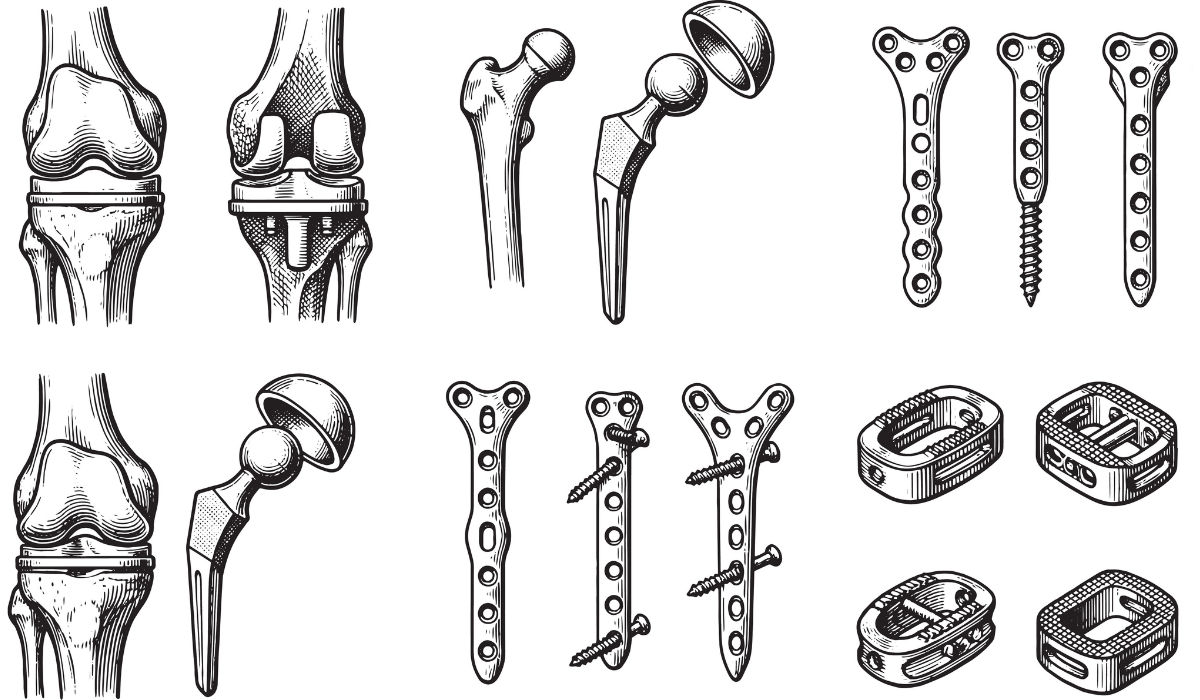
Implants serve as the backbone of orthopedic surgeries by enabling fracture healing, joint restoration, and long-term patient mobility. With rising cases of trauma from accidents, an aging population affected by degenerative conditions, and athletes pushing physical limits, surgeons face increasing pressure to deliver optimal outcomes. Selecting the right implant system is not just a technical decision but a critical factor in achieving proper alignment, ensuring load-bearing stability, and reducing the risk of revision surgeries. In this article, we’ll break down key orthopedic implant categories, their clinical applications, and important selection factors to support evidence-based decision-making.
What are Orthopedic Implants?
Orthopedic implants are surgically placed devices used to support skeletal fixation, joint replacement, or deformity correction, depending on the clinical indication. They are manufactured from biocompatible materials such as titanium alloys, stainless steel, cobalt-chrome, and PEEK, selected based on strength requirements, wear characteristics, and imaging compatibility. Functionally, these implants provide stable fixation, facilitate controlled fracture healing, or serve as joint replacement components. Their design focuses on anatomical fit, mechanical stability, and optimized load distribution to support consistent surgical outcomes.
Key Categories of Orthopedic Implants and Their Uses
Orthopedic implants are broadly classified based on anatomical region and surgical indication. Each category is designed to address specific biomechanical and reconstructive requirements, supporting stable fixation, anatomical restoration, and predictable functional outcomes.
Trauma Fixation Implants
Used for fracture stabilization, alignment correction, and restoration of limb mechanics.
- Plates and Screws
Locking and non-locking plate systems are used for periarticular and complex fractures, including distal femur and proximal humerus injuries. Titanium variable-angle screws enable multiplanar fixation and improved construct stability in comminuted fractures.
Reamed and unreamed nails with interlocking bolts are used in long bone fixation, particularly femur and tibia fractures. They support load sharing and early mobilization in diaphyseal injuries.
Monolateral and circular systems, including Ilizarov-type frames, provide adjustable stabilization. Indications include open fractures, infected non-unions, and gradual deformity correction, often serving as definitive or staged fixation.
Joint Replacement Implants
Designed for end-stage joint degeneration, structural collapse, or avascular necrosis.
- Total Hip Systems
Modular femoral stems and acetabular components with cemented or cementless fixation. Bearing combinations such as ceramic-on-polyethylene are used to reduce wear in high-demand joints.
- Total Knee Systems
Includes cruciate-retaining and posterior-stabilized designs with polyethylene inserts. Used in degenerative and post-traumatic arthritis, with alignment guided by standard or patient-specific instrumentation.
- Partial Joint Replacements
Unicompartmental knee and hemi-arthroplasty systems preserve bone stock and are indicated in localized joint compartment disease.
Spine Implants
Used for stabilization, deformity correction, and fusion procedures.
- Pedicle Screw-Rod Systems
Polyaxial screw constructs connected by rods provide segmental fixation in conditions such as spondylolisthesis and unstable fractures. Titanium and cobalt-chrome alloys are used for strength and fatigue resistance.
- Interbody Cages and Plates
PEEK and titanium cages, often used with anterior or lateral plating systems, support disc height restoration and spinal fusion while maintaining alignment and graft containment.
Cranio-Maxillofacial (CMF) Implants
Used for reconstruction of facial skeleton fractures and defects.
- Mini Plates and Screws
Low-profile systems (1.5 - 2.0 mm) used in mandibular, orbital, and midface fractures. Resorbable variants are preferred in select pediatric cases.
- Reconstruction Plates
Pre-contoured or patient-specific plates, including 3D-printed designs, are used in complex trauma or post-resection reconstruction.
Sports Medicine Implants
Focused on soft tissue repair and ligament reconstruction.
- Suture Anchors and Interference Screws
All-suture, metallic, or bioabsorbable anchors are used in rotator cuff and labral repairs. Interference screws are commonly used in ACL reconstruction for graft fixation.
- Ligament Fixation Systems
Adjustable loop devices and fixation staples are used in multi-ligament reconstruction and meniscal root repairs.
Upper and Lower Limb Implants
Designed for fracture fixation and reconstruction of extremities.
- Upper Limb Systems
Includes proximal humerus plates, distal radius volar plates, and elbow fixation systems used in osteoporotic and trauma-related fractures.
- Lower Limb Systems
Locking tibial nails, ankle fusion plates, and calcaneal fixation screws are used for high-load fractures such as pilon and Lisfranc injuries.
- Foot and Ankle Systems
Includes syndesmotic fixation and talar replacement systems for instability and avascular necrosis.
Pediatric Orthopedic Implants
Designed to accommodate skeletal growth and minimize physeal disruption.
- Elastic Intramedullary Nails and Flexible Plates
Titanium elastic nails (TENs) are commonly used in pediatric femur and tibia fractures for stable yet flexible fixation.
- Growth-Modulating Systems
Guided growth plates and magnetically adjustable rods are used in deformity correction and scoliosis management, reducing the need for repeated interventions.
Surgical Factors to Consider When Choosing Orthopedic Implants
Implant selection requires a structured approach aligned with anatomical, biomechanical, and procedural requirements. Key factors to consider when selecting orthopedic implants include:
- Anatomical Location and Fracture Pattern: Diaphyseal versus metaphyseal location influences fixation choice (nail versus plate), while intra-articular involvement typically requires buttress or anatomical plating systems.
- Patient Profile: Age, bone quality (including DEXA assessment), and activity level guide implant selection. Osteoporotic cases may require enhanced fixation strategies such as porous or augmented designs.
- Condition Type: Acute trauma cases prioritize stable and rapid fixation, while chronic deformities require corrective alignment and angular reconstruction capability.
- Surgical Technique and Preference: Minimally invasive approaches may favor percutaneous plate systems, while modular constructs support flexibility in revision procedures.
While biomechanical and anatomical factors guide implant selection, material quality and design play a critical role in determining surgical outcomes.
The Critical Role of Implant Quality in Surgical Outcomes
Implant quality plays a defining role in surgical outcomes, with engineering precision directly influencing stability, durability, and long-term performance. High-precision CNC machining ensures tight tolerances at the micron level, which is critical for maintaining secure screw–plate interfaces under repetitive biomechanical loading over time.
Biocompatibility standards such as ISO 10993 help ensure material safety and reduce the risk of adverse tissue response. Surface engineering techniques, including hydroxyapatite coatings, are widely used to support and enhance osseointegration.
Consistent manufacturing processes also reduce variability between production batches, improving reliability and reducing the risk of implant-related complications. These factors collectively contribute to improved surgical predictability, reduced revision rates, and better overall clinical outcomes, allowing surgeons to focus on procedural accuracy and patient care.
Partner With Madison Ortho
Reliable implant systems depend on consistency in design, precision in manufacturing, and alignment with clinical requirements across diverse orthopedic procedures. Madison Ortho works alongside healthcare professionals to provide a comprehensive range of orthopedic implant solutions built on standardized manufacturing practices and quality-focused engineering. Our systems are designed to support predictable performance, procedural efficiency, and broad surgical applicability across trauma, spine, reconstruction, and sports medicine applications. To learn more about our product portfolio or explore collaboration opportunities, connect with Madison Ortho at +1-787-945-5800 or email info@madisoninc.com.
Frequently Asked Questions
1. What are the main categories of orthopedic implants?
Orthopedic implants are categorized based on anatomical application and function, including trauma fixation systems, joint replacement implants, spine systems, cranio-maxillofacial (CMF) devices, sports medicine implants, and extremity fixation solutions.
2. What materials are used in orthopedic implants?
Common implant materials include titanium alloys, stainless steel, cobalt-chrome alloys, and PEEK polymers. At Madison Ortho, material selection is guided by mechanical requirements, wear characteristics, imaging compatibility, and biocompatibility standards.
3. How does implant material selection affect clinical performance?
Material properties influence fixation stability, fatigue resistance, and biological response. These factors collectively impact implant longevity and procedural predictability.
4. What factors define orthopedic implant design?
Implant design is defined by anatomical compatibility, load distribution mechanics, fixation strategy (locking or non-locking systems), and surface characteristics that support stability at the bone-implant interface.
5. When are different trauma fixation systems used?
Plates and screws are used for anatomical reduction and stabilization of fractures, intramedullary nails for long bone diaphyseal fractures, and external fixation systems for complex, open, or staged fracture management.
6. What is the role of spine implants in orthopedic procedures?
Spine implant systems, including pedicle screw-rod constructs and interbody cages, are used to achieve segmental stabilization, correct deformities, and support spinal fusion procedures.
7. How is implant quality defined in orthopedic systems?
Implant quality is determined by manufacturing precision, material consistency, mechanical strength, and compliance with recognized biocompatibility and performance standards.
8. What parameters guide orthopedic implant selection in clinical practice?
Implant selection is based on anatomical site, fracture or pathology type, bone quality, fixation requirements, and procedural goals, ensuring appropriate mechanical and functional support.
