
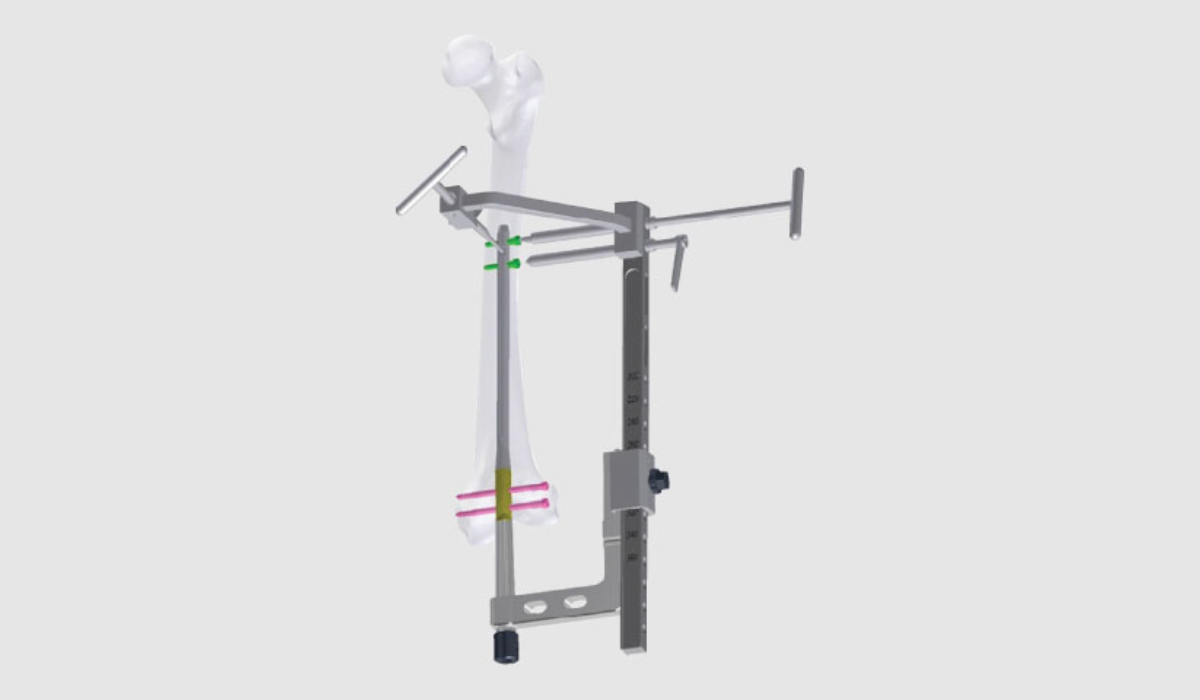
Intramedullary fixation plays a central role in modern femoral fracture management, offering stable, load-sharing support while preserving surrounding soft tissue and blood supply. Among the available fixation techniques, retrograde intramedullary (IM) nailing has become an established solution for femoral shaft and distal femur fractures, particularly in complex trauma and anatomically challenging cases.
A retrograde intramedullary implant is inserted through the distal femur to stabilize femoral shaft and distal femur fractures. By allowing fixation closer to the fracture site and offering multiplanar distal locking options, retrograde IM nails provide strong mechanical stability while supporting minimally invasive surgical principles. As orthopedic implants continue to evolve in design, materials, and instrumentation, retrograde IM nails represent a focused and reliable solution in situations where traditional antegrade approaches may present limitations. This article provides an overview of retrograde intramedullary nailing for femur, including its indications, applications, benefits, and key implant design considerations.
What is Retrograde Nailing?
Retrograde nailing is an intramedullary fixation technique in which the nail is inserted through the distal femur, typically via the intercondylar notch of the knee, and advanced proximally within the medullary canal. Once positioned, the nail is secured using proximal and distal locking screws to achieve axial, rotational, and length stability.
Unlike antegrade nailing, which requires entry through the proximal femur, the retrograde approach allows surgeons to address fractures closer to the distal femur with greater control. The intramedullary nail functions as a load-sharing implant, distributing physiological forces along the length of the femur while maintaining alignment and reducing stress concentration at the fracture site.
Retrograde femur nails are part of the broader category of intramedullary nails used across long bones. While tibia nail systems and humerus nails are typically inserted using antegrade techniques, the biomechanical principles of intramedullary stabilization remain consistent across these orthopedic implants.
Indications for Retrograde Intramedullary Nails for the Femur
Retrograde nails are indicated across a wide range of femoral fracture patterns, particularly where distal fixation, fracture complexity, or patient factors influence surgical decision-making.
1.Femoral Shaft Fractures
Retrograde intramedullary femur nails are commonly used for mid-shaft and distal shaft femoral fractures. The distal entry point allows improved control in fractures located closer to the knee joint, where antegrade approaches may compromise alignment.
2. Distal Femur Fractures
Distal femur fractures, including supracondylar fractures, often involve a wider metaphyseal region with limited bone stock. Retrograde femur IM nails provide stable fixation with multiple distal locking options, improving control in this anatomically demanding zone.
3. Pathological Femur Fractures
Pathological fractures caused by metastatic disease or other bone-weakening conditions may benefit from intramedullary fixation. Retrograde femur nails provide durable internal stabilization while minimizing soft tissue disruption.
4. Comminuted and Segmental Fractures
In comminuted or segmental femoral fractures, maintaining length, alignment, and rotation can be challenging. Retrograde femur IM nails offer strong internal support and allow locking configurations tailored to complex fracture morphology.
5. Non-Unions and Malunions
Retrograde femoral nails are also used in the management of femoral non-unions and malunions requiring internal fixation. Their load-sharing properties support fracture healing while allowing revision strategies when necessary.
Benefits of Retrograde IM Nails in Femur Applications
Retrograde IM nails offer several clinical and surgical advantages that contribute to their widespread use in femur related bone conditions.
1. Strong Intramedullary Fixation
By stabilizing the femur from within the medullary canal, retrograde femur IM nails provide robust internal support. The load-sharing nature of intramedullary nails promotes physiological stress transfer, supporting fracture healing while reducing implant fatigue.
2. Enhanced Distal Stability
Modern retrograde femur nails offer multiple distal locking options in multiplanar directions. This feature is particularly valuable in distal femur fractures, where enhanced fixation is required to control rotation and prevent varus or valgus collapse.
3. Minimal Soft Tissue Disruption
Retrograde nailing avoids extensive dissection around the hip musculature. When performed with appropriate technique, it supports minimally invasive principles and helps preserve surrounding soft tissue and vascular supply.
4. Surgical Efficiency
The distal entry approach allows straightforward patient positioning and streamlined surgical workflow, particularly in trauma settings. This efficiency is an important consideration in high-volume orthopedic centers.
5. Support for Early Mobilization
Stable fixation achieved with a well-designed intramedullary femur nail can support early mobilization and rehabilitation when clinically indicated, contributing to improved functional recovery.
Key Considerations When Using Retrograde IM Nails for the Femur Bone
Despite their advantages, retrograde femur IM nails require careful planning and execution to ensure optimal outcomes.
1. Entry Point Precision
Accurate placement of the distal femoral entry point is critical. Improper positioning may result in malalignment, joint cartilage damage, or compromised fixation. High-quality instrumentation and fluoroscopic guidance are essential.
2. Knee Joint Management
Because the retrograde approach involves passage through the knee joint, surgeons must consider pre-existing knee conditions and postoperative rehabilitation. Implant design and surgical technique play a significant role in minimizing knee-related complications.
3. Locking Configuration
The choice of static or dynamic locking depends on fracture type, bone quality, and stability requirements. Multiple distal locking options improve adaptability across fracture patterns.
4.Implant Sizing and Geometry
Correct nail length, diameter, and curvature selection are crucial for achieving optimal canal fit. Anatomically contoured designs help accommodate femoral bow and reduce stress concentration.
5. Patient Selection
As with all intramedullary nails, individual patient factors such as bone quality, fracture location, and comorbidities influence the suitability of retrograde femur IM nailing.
What to Look for in Retrograde IM Femur Nail Implants
For surgeons and hospitals evaluating orthopedic implants, implant design and manufacturing quality directly influence clinical outcomes.
- Anatomically Contoured Nail Design: A retrograde intramedullary femur nail should reflect femoral anatomy, including appropriate curvature and distal geometry, to improve alignment and ease of insertion.
- Multiplanar Distal Locking Options: Multiple distal screw configurations enhance fixation strength, particularly in osteoporotic or metaphyseal bone.
- Material Quality and Durability: High-quality titanium or stainless steel alloys provide strength, fatigue resistance, and biocompatibility essential for long-term implant performance.
- Instrumentation Integration: Reliable orthopedic implants are supported by intuitive instrumentation that allows accurate nail insertion and locking. Consistency across femur, tibia nail, and humerus nails reduces complexity for surgical teams.
- Manufacturing Standards: Adherence to international quality and regulatory standards ensures consistency, traceability, and performance reliability.
Retrograde Femur Nails Within a Comprehensive Intramedullary Portfolio
Retrograde femur nails are most effective when offered as part of a complete intramedullary implant portfolio. Alongside antegrade intramedullary femur nail systems, tibia nail solutions, and humerus nails, retrograde femoral nails provide surgeons with flexible fixation options tailored to fracture location and complexity.
For implant manufacturers, a comprehensive intramedullary offering reflects a commitment to addressing real-world orthopedic challenges through thoughtful design, consistent instrumentation, and dependable manufacturing processes.
Advancing Femoral Fracture Fixation Through Purpose-Driven Implant Design
Retrograde IM nails represent an important advancement in femoral fracture fixation, particularly for distal femur fractures and complex trauma cases. When supported by precise engineering, reliable instrumentation, and rigorous manufacturing standards, these implants deliver predictable fixation and consistent clinical performance.
At Madison Ortho, this philosophy is reflected in the development of orthopedic implants that balance anatomical compatibility, mechanical strength, and surgical practicality. Our intramedullary portfolio, including femoral systems such as Seine and other purpose-built solutions, is designed to support modern femoral fracture care across routine and complex indications. To learn more about our product range, call +1-787-945-5800 or email info@madisonorthoinc.com and a representative will connect shortly.
