
Key Takeaways
|
Material selection is an important consideration in the design and development of spinal implants, as the material can influence the mechanical and functional characteristics of an implant system. Titanium, PEEK, and other materials are used across different spinal applications, with each offering properties suited to specific implant requirements. Understanding the characteristics of these materials can help clarify why certain materials are used for particular applications. This article examines the key materials used in spinal implants, their properties, and the factors that influence their selection.
Importance of Choosing the Right Material in Spinal Implants
The material used in a spinal implant influences how well it behaves under mechanical stress, interacts with surrounding structures, and performs within the intended spinal application. Some of the key things influenced by material choice include:
- Implant Strength: Material properties determine how well an implant can withstand the mechanical loads placed on it during and after surgery.
- Flexibility: The stiffness and elasticity of a material influence how an implant responds to forces and how loads are transferred between the implant and surrounding structures.
- Bone Interaction: The material and its surface characteristics can affect how the implant interacts with bone, particularly in applications where spinal fusion is intended.
- Imaging: Different materials have different imaging characteristics, which can influence implant visibility and the assessment of surrounding anatomy during postoperative imaging.
- Long-Term Performance: Resistance to wear, corrosion, fatigue, and other forms of material degradation can affect how an implant performs over time.
- Implant Design: The properties of a material also influence how an implant can be designed and manufactured, allowing different materials to serve specific implant types and spinal applications.
Read Also:A Brief Guide To The Major Types Of Orthopedic Screws
Types of Materials Used in Spinal Implants
Spinal orthopedic implants can be made from different materials, with each offering properties suited to particular implant designs and applications. Spinal implant portfolios commonly include titanium, titanium alloys, and PEEK, with some systems combining more than one of these materials.
Titanium
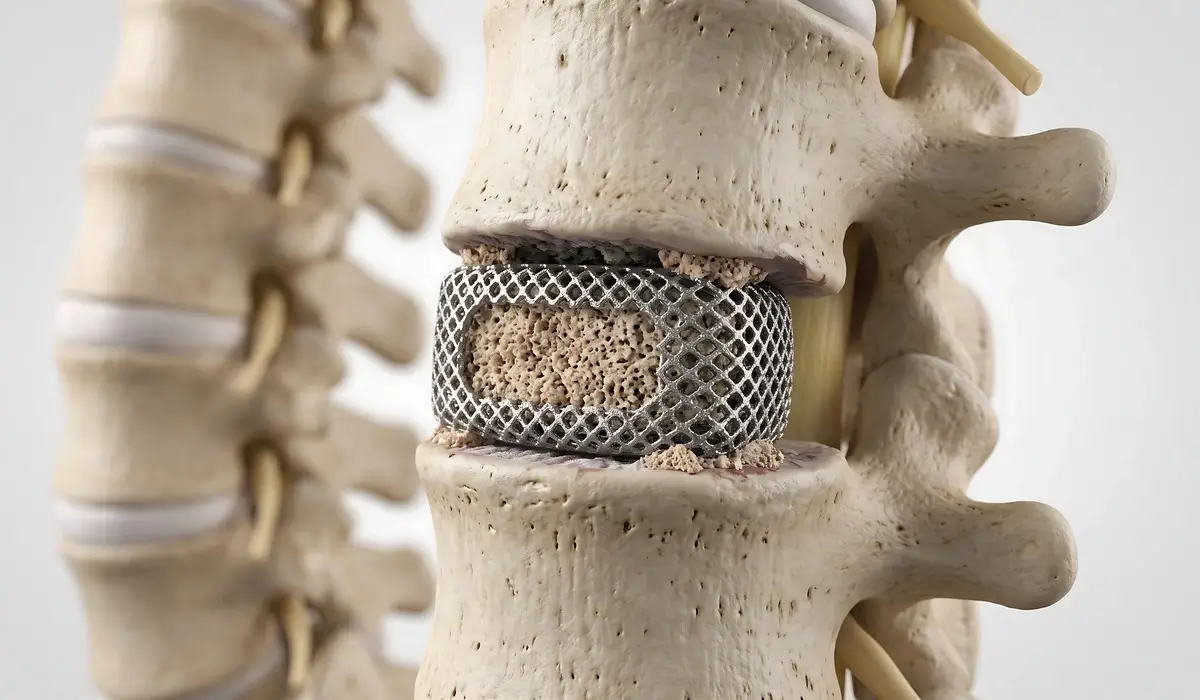
Titanium is a lightweight metal known for its high strength, corrosion resistance, and biocompatibility. Its combination of strength and relatively low density makes it suitable for implants that need to provide structural support without adding unnecessary weight.
Titanium also has a long history of use in implantable medical devices because it can withstand the demands placed on implants over extended periods. In spinal applications, it can be used in components such as cages and fixation devices. Madison Ortho's EARTH Titanium Mesh Cage is one example of a spinal implant made from titanium.
Titanium Alloys
Titanium alloys are created by combining titanium with other elements to modify its mechanical properties and improve its suitability for specific implant applications. Ti-6Al-4V is one of the most widely used titanium alloys in medical implants because it offers high strength, corrosion resistance, and biocompatibility.
In spinal implants, these properties are particularly useful for components that need to withstand significant mechanical loads. Titanium alloys are therefore commonly used in fixation components such as screws, rods, plates, and hooks. Madison Ortho uses Ti-6Al-4V across several of its spinal fixation systems.
PEEK
Polyetheretherketone, or PEEK, is a high-performance thermoplastic polymer that has become an important material for spinal interbody implants. It has a lower elastic modulus than metals, allowing its mechanical behavior to more closely resemble that of bone.
Another important characteristic of PEEK is its radiolucency. Unlike metals, PEEK produces limited interference on X-rays and CT scans, which can make it easier to evaluate the surrounding anatomy and assess the fusion area after surgery. Its combination of mechanical properties, chemical stability, and radiolucency has made it particularly useful for interbody cages used in orthopedic & spine surgery.
Read Also: A Guide to Types of Orthopedic Implants and Their Uses
PEEK And Titanium
Some spinal implant systems combine PEEK and titanium rather than relying on a single material throughout the implant. This approach allows different components to provide different functions within the same system.
For example, a PEEK spacer can provide the characteristics required of an interbody component, while titanium alloy can be used for fixation components that require greater mechanical strength. Madison Ortho's MINERVA Variable Angle ACIF Cage System uses this type of combination, incorporating a PEEK spacer with titanium alloy components.
Titanium vs PEEK: What is the Difference?
Titanium and PEEK have different mechanical and imaging properties, which makes them suitable for different spinal implant applications. Titanium is a strong and rigid metal commonly used for fixation, while PEEK is a radiolucent polymer used mainly in interbody cages.
|
Property |
Titanium |
PEEK |
|
Material |
Metal |
Polymer |
|
Strength |
High |
Lower than titanium |
|
Stiffness |
High |
Closer to bone |
|
Imaging |
Radiopaque |
Radiolucent |
|
Common use |
Screws, rods, plates, fixation, and some cages |
Interbody cages |
|
Key advantage |
Strength and structural stability |
Bone-like elasticity and reduced imaging interference |
The difference in stiffness is particularly relevant to load transfer between the implant and surrounding bone, while PEEK's radiolucency can make postoperative imaging easier to assess. This is why the two materials are often used for different roles within spinal implant systems rather than one being considered universally better than the other.
How Implant Materials Affect Imaging
The material used in a spinal implant can affect how clearly the implant and surrounding anatomy appear during postoperative imaging.
Metal implants such as titanium are radiopaque, which makes them readily visible on X-rays and CT scans, but they can also create artifacts that may affect the visibility of nearby structures.
PEEK, in contrast, is radiolucent and produces less interference on these imaging modalities, allowing the surrounding bone and anatomy to be visualized more clearly.
This difference can be particularly relevant for interbody cages, where imaging may be used to assess implant position and the progress of spinal fusion. PEEK implants may also incorporate radiopaque markers to help identify their position despite the material itself being radiolucent.
These imaging characteristics can therefore influence how implants are monitored after surgery and treatment, particularly when postoperative imaging is needed to assess implant position or the surrounding anatomy.
What Factors Affect Spinal Implant Material Selection?
The choice of material depends on the role an implant needs to perform and the demands placed on it within the spine. Key factors that can influence material selection include:
- Implant Type: Fixation screws, rods, plates, and interbody cages have different functional requirements, which can influence the materials used in their design.
- Spinal Application: The requirements can vary based on the spinal region and procedure, such as cervical fusion, lumbar fusion, deformity correction, or vertebral body reconstruction.
- Mechanical Requirements: The expected loads and forces on an implant need to be considered when determining the strength, stiffness, and fatigue resistance required from the material.
- Bone Interaction: The relationship between the implant and surrounding bone can influence material selection, particularly for implants intended to support spinal fusion.
- Imaging Requirements: The need to visualize the implant and surrounding anatomy during postoperative imaging can also affect the choice between radiopaque and radiolucent materials.
- Implant Design: The properties of a material can influence how an implant is designed and manufactured, as well as how it can be incorporated into different surgical techniques.
Conclusion
Selecting an appropriate material is an important part of spinal implant design, as material properties can influence mechanical performance, imaging characteristics, and suitability for different spinal applications.
Madison Ortho develops and manufactures orthopedic implant systems designed to address a range of surgical requirements, including spinal fixation, interbody fusion, and spinal reconstruction. Its spine portfolio includes titanium and titanium alloy fixation systems, PEEK interbody cages, and implant systems that combine different materials within a single design. For surgeons, hospitals, distributors, and other medical device professionals looking to explore Madison Ortho's spinal implant portfolio or discuss potential collaboration opportunities, connect with Madison Ortho at +1-787-945-5800 or email info@madisoninc.com.
Frequently Asked Questions
Are spinal implant materials resistant to corrosion?
Titanium and titanium alloys offer strong corrosion resistance, which is important for implants intended to remain in the body for extended periods. PEEK is a chemically stable polymer and does not corrode in the same way as metallic implant materials.
Can spinal implant materials be sterilized?
Yes. Materials used in spinal implants are selected to withstand validated sterilization processes without compromising their required physical or mechanical properties. The appropriate sterilization method depends on the specific implant and its design.
Do spinal implant materials affect implant weight?
Yes. Material density can influence the overall weight of an implant. Titanium has a relatively low density compared with many other metals, while PEEK is considerably lighter because it is a polymer.
Can spinal implants be manufactured using 3D printing?
Yes. Additive manufacturing can be used to produce certain spinal implants, particularly those made from titanium and other suitable materials. It can allow manufacturers to create complex geometries and controlled porous structures that may be difficult to produce using conventional manufacturing methods.
How does manufacturing affect spinal implant material performance?
Manufacturing processes can influence characteristics such as surface finish, dimensional accuracy, porosity, and mechanical performance. These factors need to be controlled to ensure that the finished implant meets its intended design and performance requirements.
Can different materials be used in the same spinal implant system?
Yes. Some systems combine materials so that different components can provide specific mechanical or functional characteristics. For example, a spinal system may combine a PEEK interbody component with titanium alloy fixation components.